19.Shaping our Project Approach with Lived Experience Experts
Research focus
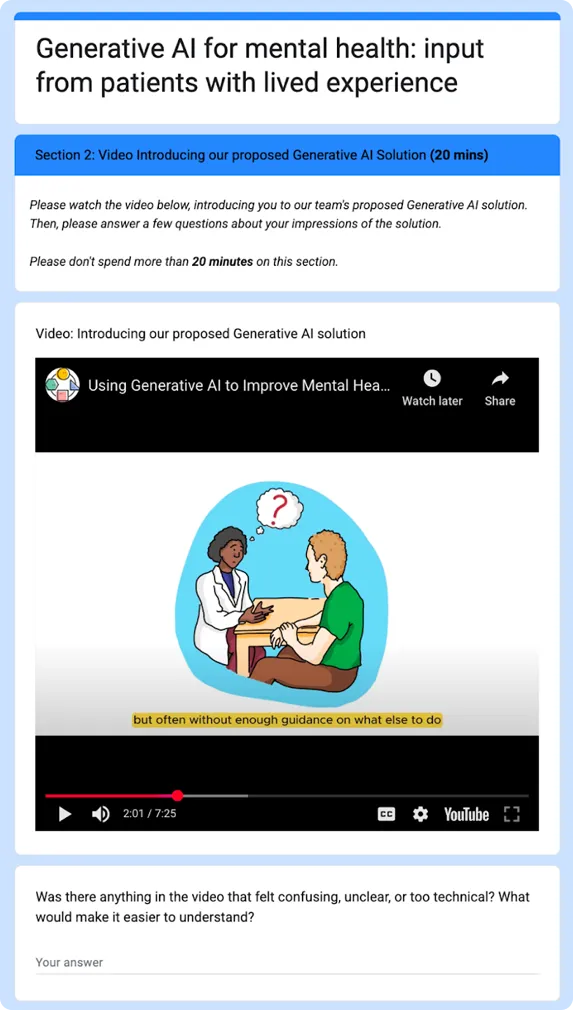
Video of our proposed gen AI solution and written summaries of our proposed research approach and our patient and public participation and involvement (PPIE) plan
Participant focus
People with with lived experience of depression, anxiety, or bipolar disorder
What we did
We distributed a qualitative survey to six people with lived experience (PWLE) of depression, anxiety, or bipolar disorder. Four participants were based in Greater London and two in Nottinghamshire. The survey invited them to review a short video explaining our proposed GenAI solution, along with written summaries of our research plan and our approach for patient and public participation and involvement (PPIE) throughout the project. Participants were asked to share their views on the value of each of these, any concerns they had, and suggestions to ensure the project meets the needs of people with lived experience.
What we found
Participants strongly resonated with the problem the project aims to address. Many described feeling lost in the current system, particularly when long waiting times and limited access to specialist care lead to uncertainty, frustration and, at times, a loss of hope. They felt that the proposed GenAI tool could meaningfully improve access to high quality mental health support, especially for people with complex needs, by helping patients feel more informed and more actively involved in their treatment decisions.
At the same time, participants emphasised the importance of ensuring the tool is reliable and accurate, and that it supports rather than replaces human clinical judgement. They expressed confidence that strong oversight from clinicians and rigorous testing would help safeguard quality. They also stressed the need for equitable implementation across the NHS so that benefits are shared widely, not just concentrated in a small number of services.
In reflecting on the broader research approach, participants placed high value on engaging both PWLE and primary care clinicians throughout the discovery, design and evaluation phases. They appreciated the project’s focus on safety evaluation and risk mitigation, and encouraged further exploration of how the tool could be implemented across different healthcare contexts, both across the UK and beyond.
Participants also responded very positively to the plan for PPIE in the project. They welcomed the emphasis on meaningful and ongoing involvement through an advisory group, and several expressed interest in taking on these roles themselves. They highlighted the need for diversity within PWLE contributors, ensuring that a wide range of mental health experiences and backgrounds are represented. Finally, they stressed the importance of sharing findings with the broader community at each stage of the research, reinforcing transparency and public benefit.